I Will Not Accept AI-Generated Writing

Terror: The anticipation and dread before a frightening event has occurred.
Horror: The revulsion or shock after a frightening event has occurred.

When Google Translate and early AI translation acquisition tools first hit the internet, my French, Spanish, and all other language teachers marked assignments and the students who used this these tools harshly. These teachers had the knowledge required to identify non-typical conjugations and inappropriate grammatical usage that would make understanding difficult.

Terror: The idea that computerized language acquisition models will replace Interpreters without understanding or accuracy.

Human Interpreters have trained themselves to understand the origin of languages and their cultural contexts, and to excel at their skills they must understand the current state and natural evolution of language.

AI translation and acquisition tools lack true understanding, context, and the ability to self-evolve as their environments change (ChatGPT has consistent roll-backs and sections of code that it is not permitted to rewrite).

Horror: A graduate student who used ChatGPT to supply references for their definitions of childhood did not check if any of the supplied references were written by a convicted pedophile. Specifically, their most utilized reference.

Question: What could have caused an individual so genuinely passionate about their topic to use AI language tools in order to source references rather than their library?

Answers: I found many possible reasons:

  • Their school accepts students who do not have any formal training in the area of their graduate program and puts the onus on these students to “catch up” to the program rather than address the failings of the acceptance requirements.
  • Their school library is underfunded and does not have adequate access to academic information.
  • They were not adequately taught the process of researching for a thesis.
  • They were not taught the process of writing a 150+ page document and burnt out trying.

As a tutor for university students, I help many people develop their ideas, arguments, and writing style. I am very accurate at identifying when students have used AI (ChatGPT, etc.) to generate their ideas, arguments, research streams, research articles, citations, academic summaries, personal discussion posts, Master’s and Ph.D. theses, and more.

As an artist, I have learned not to blame my tools because I have not learned how to use them. I help train people on appropriate uses for AI, how AI works, and how to look elsewhere for more accurate answers.

My Position

I will not provide editing support on any document that was created using AI language tools.

This includes:

  • Generating full or partial paragraphs
  • Rewriting sentences for tone, grammar, or structure
  • Submitting questions to AI and paraphrasing the responses
  • Using AI to “brainstorm” arguments or conclusions
  • Asking AI to create outlines or thesis statements

If I suspect your writing was generated or rewritten by an AI tool:

  • I will tell you and it is your responsibility to provide evidence to the contrary
  • You will admit to what you have done and restart, completely, in front of me (over video-conferencing).
  • You will learn why this is not a good thing and how to use AI tools responsibly.
  • We will develop templates to follow when generating ideas and throughout the writing process.
  • I will tell your professor(s) if you continue to use AI tools irresponsibly as per each course’s individual academic dishonesty policies (Note: If your course instructors do not care about AI tool usage, then I need to have proof of this).

I am here to help develop your voice, ideas, and arguments; I am not here to edit work generated by AI algorithms so that they sound more human and can pass an AI detector.

You need to identify which ideas are YOURS and which ideas are not. To learn requires effortful, directed practice; if you outsource your thinking to a computer, then the computer is making the effort and not you.

Academic and creative integrity depend on personal interest, effort, and true understanding. If you do not understand what you are writing about, ask for help from kind people.

Do Not Use AI to Write in English

Most of my students have a birth language that is not Canadian English, but they must submit their final writing assignments using appropriate Canadian English.

For these students: I cannot recommend using AI language tools when writing assignments.

Instead:

  • Brains need context to learn properly: Consider generating and considering ideas in the language that is most familiar to you if it is more comfortable.
  • Translate and interpret all relevant terminology and definitions between your most familiar language and the language you use to submit writing assignments.
  • Keep a table of common and uncommon terminology.
  • Download a table of common and uncommon grammatical rules for both languages so that you can interpret your familiar language’s writing style into the language you use to submit writing assignments.

Tables: Is AI Generation Acceptable When…

Research and Planning

Type of UseAcceptable?Notes
Generating a to-do list of questions to guide your researchYESThese must be refined and expanded by the student and supervisors
Creating a general template or structure for your workflowYESThis could include asking for a checklist of sections in a research paper, must be refined and expanded after verifying with publication sources
Asking AI to help identify relevant keywords for a research topicSPECIFIC USE CASEThese provided keywords must be used as a suggestion and not as a definitive list. Verify and expand the list with academic sources and supervisors
Clarifying ideas for topics or research questionsSPECIFIC USE CASEAI can be used to generate prompts for clarification, but the student needs to verify answers with external supports and supervisors
Generating ideas for topics or research questionsNOThis is a matter of student interest, understanding, and research ability. If you do not have any ideas, you need to take a break and reconsider your stress level

Writing and Drafting

Type of UseAcceptable?Notes
Asking for a unique example of your own ideasSPECIFIC USE CASEThese examples can only be used for inspiration, not as part of your final content
Providing a summary of articles or researchNOWhile this can be helpful if you already read the article, AI generative content will never be able to identify all the important pieces within the article or research
Applying a carefully constructed summarization template to an articleSPECIFIC USE CASEA) The AI must be instructed to i) supply information verbatim in point form AND ii) include page and paragraph numbers for each point; B) The student must verify all information personally to ensure no motivations or concepts have been misrepresented or missed
Asking for rewording suggestions to improve claritySPECIFIC USE CASESuggestions must be reviewed and rewritten by the student to reflect their understanding, writing style, and tone
Asking for an evaluation of a section’s overall organizationYESSuggestions must be reviewed and rewritten by the student to reflect their goals, understanding, writing style, and tone
Asking for a basic template to consider when developing sentences and paragraphsYESSuggestions must be reviewed the student and supervisor to reflect their goals, writing style, and tone
Drafting sections based on your own research and analysisNOThe student must write these sections independently, not by relying on AI
Paraphrasing content to simplify itNOThis can misrepresent the meaning and impact your academic integrity
Writing parts of a draft based on your outlines and researchNOAI-generated drafts replace your intellectual effort
Rewriting for clarity or toneNOYour writing should reflect your understanding and voice
Organizing content for personal projectsSPECIFIC USE CASEAs long as the ideas and works are a) personally developed AND b) in your own words AND c) the information is publicly available and un-ownable

Two Sides of the Same Fear: The Hive Mind vs. the Mindless Zombie

The Fear of Loss

In many forms of popular culture, from dystopian novels to horror films, two recurring archetypes capture our collective anxieties: The “hive mind” and the “mindless zombie.” At first glance, these tropes appear to represent opposite ends of a spectrum—one governed by rigid control, the other by chaotic anarchy, but both tap into a shared fear: The terror of losing individuality, autonomy, loved ones, and ethics in the face of overwhelming, dehumanizing forces. This blog post explores how these seemingly opposing fears reflect similar concerns about our place in society, the impact of conformity, and the consequences of isolation.

The Hive Mind: Fear of Overbearing Control

The “hive mind” is often depicted as a collective entity that suppresses individuality in favor of a singular, all-powerful will. Popular examples include the Borg from Star Trek, the Mind Flayer from Dungeons and Dragons, and the authoritarian dystopias in George Orwell’s 1984. These narratives center around a domineering force that enforces strict conformity, with all members abandoning their personal beliefs, desires, and agency.

Root of the Fear: At the heart of the “hive mind” trope is the fear of control and loss of individuality by an external force—be it a government, corporation, or alien species—that imposes its ideology on the masses. This serves as a metaphor for the dangers of extreme conformity, the horror that lies in the loss of free will and the erasure of diversity. This fear is deeply tied to real-world anxieties about authoritarianism, social surveillance, and the suppression of alternate voices and ideas.

Loss of Individuality & the Fear of Communism/Socialism: A historical manifestation of this fear is the perception of communism and socialist ideas, particularly during the Cold War era, where capitalist societies typically depicted communism and socialism as a force that would strip individuals of their autonomy, transforming them into mindless drones serving a collective ideology. The portrayal of communism as a mindless, collective system reinforced this idea, suggesting that a society based on shared resources and collective ownership would turn people into automatons devoid of personal agency. While these ideologies are defined as advocating for collective ownership, equality, and social welfare, there is a tendency for unethical political leaders and platforms to operate under the name communism or socialism while consolidating power in the hands of a few, undermining democratic principles, and suppressing dissent, thereby distorting the original ideals for personal or political gain. This includes Stalin’s Russia, and modern political platforms such as those in North Korea, where leaders have used the rhetoric of socialism and communism to justify centralized control, suppress political opposition, and maintain power within a small elite group, often at the expense of the broader population’s freedoms and well-being. The misuse of ideological frameworks for personal or political gain can distort the core principles of equality, social welfare, and collective ownership, resulting in authoritarian regimes rather than the egalitarian societies originally envisioned.

Resolution and Misconceptions: The “Destroy the Leader” Response: A typical resolution in hive mind narratives often involves the idea of severing the controlling force, frequently symbolized by the destruction of a central figure, such as the queen or leader. This mirrors historical responses to oppressive systems, where revolutions or rebellions aimed to overthrow individual leaders (or dictators) in the hope that their removal would restore freedom and “return to normal.” The logic is simple: Remove the source of control, and everything else will naturally fall back into place. However, this is an inaccurate and overly simplistic view of power structures. In reality, the collapse of a centralized power does not always lead to a return to normality. Often, it leads to chaos, instability, or even the rise of new, equally authoritarian systems. One example from reality is the aftermath of the Russian Revolution in 1917: The collapse of the Tsarist autocracy, which was seen as a centralized and oppressive power, did not immediately lead to a return to stability or “normality” as many had hoped. Instead, it resulted in chaos and civil war, culminating in the rise of the Soviet Union under Lenin and later Stalin. While the Bolsheviks promised equality and the dismantling of oppressive systems, the new regime became increasingly authoritarian, with a centralized power structure that suppressed dissent, led to widespread purges, and created a totalitarian state that mirrored some of the very characteristics of the Tsarist system it had overthrown.

Appropriate Resolution: Proper responses to dismantling oppressive power should focus on creating a just and stable society by prioritizing the rule of law, inclusivity, and accountability. This involves establishing transparent, valid, reliable, and unbiased systems and methods to hold all individuals accountable, ensuring minimum ethical requirement for all individuals seeking office to allow diverse political participation, and fostering a vibrant civil society where community-based organizations and grassroots movements can thrive. Economic equity must be addressed through redistributive policies that reduce disparities, while decentralized power structures and civic education help prevent the rise of new authoritarian systems. Ultimately, the goal is to rebuild a society that balances justice, individual freedoms, and social cohesion while avoiding chaos and the consolidation of power into the hands of those who will misuse it.

The Mindless Zombie: Fear of the Unknown and Unreasoning Forces

While the “hive mind” is associated with controlled, systematic ideologies, the “mindless zombie” trope embodies a slightly different kind of terror: The fear of an all-consuming force that is both irrational and incapable of being reasoned with. Zombies represent a shift in understanding and knowledge: Unlike traditional leadership structures where killing the leader might end the movement, the horde continues onward.

Root of the Fear: There are three common fears associated with zombies, affecting the individual, power structures, and the future of society. Individual zombies can represent a detrimental change in ourselves or our close relationships: The unwilling loss of individuality and control due to an unknown, uncontrollable being that is blind to reason, empathy, or compromise. Viewing the horde from the perspective of a solitary individual, it represents the feelings of powerless against forces that seem overwhelming, in which all individuals share the same overwhelming abilities and a singular, unyielding, and dangerous goal. This may also reflect the fear of a mindless, unstoppable force of detrimental societal change—one where individuals are no longer autonomous but are swept up in hunger or hatred that drives them towards their goal, regardless of resistance or reason. Finally, the zombie apocalypse often represents our collective fear that hunger, fear, pain, rage, and hatred will doom both humanity’s and the world’s future. In this context, zombies are an exaggerated expression of the dread we feel toward both known and unknown threats—be they viruses, environmental collapse, or social upheaval.

Loss of Individuality & the Fear of a Negative Societal Shift: The fears that zombies symbolize go beyond personal loss of control and touches on a larger existential anxiety: The fear of a negative societal shift, where human progress in learning, equity, and shared prosperity is abandoned in favor of mindless, destructive behaviour. Much like the fear of a mindless zombie horde consuming society, there is a growing concern that current social trends—be they driven by misinformation, political division, or unchecked technological advances—could steer humanity away from ideals of justice, progress, and equity.

The fear of an unstoppable, mindless force that wishes to rocket humanity back into the prehistoric age is not without basis. It speaks to a very real and deep-rooted anxiety about individuals, power structures, and forces in this world that are incapable of ethical reasoning, and cannot be easily avoided or combated. These individuals, power structures, and forces exist today, and are interested in preventing or eliminating equality, diversity, and inclusivity so that they can achieve power for their own desires. They typically operate by creating division between individuals with noticeable differences and designating certain individuals to be seen to be lesser (i.e., children, women, gender-diverse and transgender individuals, and demographic differences between individuals) and therefore permit the abuse by individuals perceived as greater. There are many areas in which these individuals, power structures, and forces operate: Academic (The historical exclusion of non-White individuals and women from access to higher education, such as the denial of enrollment to African Americans in U.S. universities during the Jim Crow era, and the systematic marginalization of women in academic institutions), Health (physical, psychiatric, and psychological mistreatment of non-White individuals, women, LGBTQIA+2S individuals, and those inappropriately deemed “insane,” such as forced sterilizations of marginalized populations or discriminatory medical practices, like the overdiagnosis of mental illness in Black communities or the criminalization of transgender individuals seeking healthcare), Political (the historical Canadian marginalization, imprisonment, and cultural genocide of Indigenous communities such as the forced relocation of Indigenous peoples from their ancestral lands, the residential school system aimed at eradicating Indigenous languages and cultures, and the ongoing violence and discrimination faced by Indigenous people), Societal (Systems of systemic inequality like the caste system in India, where lower castes face social exclusion, violence, and discrimination), Spiritual (Roman Catholicism human rights violations regarding Indigenous populations, Women, & LGBTQIA+2S including such removal of children from their families, forced religious conversion, and conversion therapy; ISIS promotion of male power through the subjugation of Women & LGBTQIA+2S individuals, including the brutal enforcement of gender segregation, honour killings, and forced marriages to maintain patriarchal control), and more.

Resolution and Misconceptions: The “Destroy Them All” Response: It often seems as though “Destroy All the Zombies” —often through extreme violence and/or devastation to innocent life forms— is the only true method to restore peace, order, and safety. This mentality feeds into the idea that existential problems can be solved by a simple, decisive action, without considering the long-term consequences or the complexity of the situation. In reality, such a strategy often fails to address the root causes of societal breakdowns or chaotic events. Just as killing the zombies does not necessarily guarantee the resolution of the societal collapse they represent, destroying a perceived threat in real life—be it through violence, military intervention, or radical elimination of opposing forces—rarely leads to the restoration of a stable, functioning society, but instead it often results in further instability, power vacuums, or the rise of new authoritarian structures, as the underlying social, economic, or political issues that allowed for the breakdown to happen in the first place remain unresolved or further exacerbated.

Appropriate Resolution: Resolution to the zombie problem—whether in fiction or in real-world analogs—lies not in the wholesale destruction of the “other,” but in understanding that survival and progress are about more than just eliminating threats. They are about finding ways to understand and address the systemic issues that created the crisis in the first place, and to ensure that humanity does not lose its core values of empathy, justice, and reason in the process. Many zombie films suggest that survival depends on peoples’ ability to seek comfort, strength, and refuge in each other, developing ethical social structures to prevent the development of authoritarian power structures, and adapting to the environmental changes as they occur. The resolution is not about control and conformity, but instead about accepting the reality of the situation and learning what can be done in order to better ourselves within it and working together to create new systems of survival and understanding. This mirrors the real-world necessity of adapting to unforeseen challenges—whether they come in the form of ethical, social, environmental, political, or personal crises.

Extremes Are Rare, but Our Minds Are Built to Consider Them

It is important to remember that the extremes represented by the “hive mind” and “mindless zombie” tropes are extremely rare. Our minds are naturally wired to consider extreme dangers because they help us develop strategies to avoid or mitigate potential threats. These extreme dangers are not always as prominent, imminent, or as severe as they appear: In reality, many societies tend to fall somewhere in between, navigating complexities and finding ways to balance individual freedoms with collective responsibilities. It is important to recognize and confront fear-based rhetoric from individuals or groups who benefit from controlling others can amplify these exaggerated fears, and act in a way that prevents the control of ourselves and others by these individuals or groups. Whether through misinformation, sensationalized media, or political rhetoric, these voices can distort our understanding of reality. Recognizing these mental and social processes can help us regain a sense of balance. By actively questioning the validity of extreme fears, seeking out information, and considering the long-term consequences of our actions, we can move away from reactive fear-based thinking toward more informed, rational decision-making.

The fear of hive minds and zombies are a useful symbolic warning, highlighting the potential consequences of ignoring societal problems, disregarding collective responsibility, and underestimating the impacts of dangerous ideologies or movements. It forces us to confront the idea that while we may feel powerless against larger forces, it is still possible to resist the mindless march toward destruction by fostering a more reasoned, inclusive, and empathetic world.

A Road to Healing and Stability

I have hopefully convinced you that dismantling oppressive power structures is a necessary but complex process. To prevent the emergence of new forms of oppression and ensure a peaceful transition to a just society, it is essential to implement strategies that prioritize the understanding, inclusivity, solidarity, economic equity, and the prevention of authoritarian tendencies. While the path to rebuilding a fair and democratic system is not without challenges, history has shown that with careful planning and a commitment to justice, societies can overcome oppression and create a future that respects the dignity and autonomy of all individuals.

We made it here. We can make it further.

Initial Publication: 2024-11-12

Decolonization and the History of Psychological and Psychiatric Care

Decolonization and the History of Psychological and Psychiatric Care

Psychological and psychiatric care around 1900 was punitive and institutionalizing, and extreme critics of psychiatry were often unwillingly labeled as antipsychiatry (Burston, 2018; Chapman, 2016), meaning opposition to the “treatment of mental diseases” (Tuke, 1892a, p. 1013). Labeling critics of unethical psychiatric practices as antipsychiatry conflicts with recent efforts toward decolonizing psychological care: Freeing it from the framework that emphasized control over other peoples, cultures, and land (OHRC, n.d). As of 2021, both the Canadian Psychiatric Association and the Canadian Counselling and Psychotherapy Association have acknowledged the harm caused by racialized, exploitative practices in psychiatric and psychological policy (CCPA, 2021; CPA, 2020; Kanani, 2011; Matheson et al., 2022) and require practitioners to develop awareness and ensure cultural safety (CCPA, 2021; CPA, 2020), particularly when approached by Indigenous clients with intergenerational trauma (Matheson et al., 2022). This paper uses a decolonization perspective to review the origins of the term antipsychiatry and the most valid points made by the opposition to unethical psychiatry practices in the 1900s.

The textbook The History of Modern Psychology claims that antipsychiatry was a movement started by psychiatrists Thomas Szasz and Ronald D. Laing in the 1960s (Pickren & Rutherford, 2010) but the term antipsychiatry originated in 1912 with psychiatrist Bernhard Beyer, who used it to describe more extreme critiques of psychiatry’s institutionalizing nature (Burston, 2018); taken literally, antipsychiatry suggests these critiques opposed “the treatment of mental diseases” (Tuke, 1892a, p. 1013). This label was rejected by patients, families, friends, and professionals at the time, and also in the 1960s with both Szasz and Laing, as most recognized the harmful effects of psychiatric asylums and sought reform, not abolishment, of psychiatry (Burston, 2018; Chapman, 2016). The only person to claim the term in writing was a politically unorthodox, counter-culture-supporting psychiatrist David Cooper in the 1960s (Burston, 2018), who participated in anti-apartheid and anti-capitalism movements (Chapman, 2016). Decolonizing psychiatry requires accurately representing these critiques as efforts to improve, rather than dismantle, the field, ensuring a more just approach to mental health care.

Understand concerns before mislabeling reform movements.

Valid criticisms of psychiatry and the power held by psychiatrists originated before 1900 (Burston, 2018) and will continue beyond the 2020s. Two thematic criticisms from the 1900s will be discussed: The first involves psychiatrists’ ethics and the use of asylums to isolate, restrain, and sedate anyone deemed insane. It was noted that the punishing and institutionalizing nature of psychiatry permitted psychiatrists much freedom with the individuals whom they deemed insane and committed to psychiatric asylums: Patients between the 1900-1960s commonly included political activists, sexual minorities, women who did not conform to their husbands wishes, or any other person who acted against the social power structure (Burston, 2018).

The vague definitions of insanity as “not healthy” (Tuke, 1892a, p. 692) and “unsound” (Tuke, 1892a, p. 694), left room for abuse due to their lack of appropriate diagnostic criteria. From a decolonization perspective, these practices reflect how psychiatry was historically weaponized to reinforce social hierarchies and suppress marginalized groups. By labeling political dissenters and social nonconformists as insane, psychiatry contributed to colonial frameworks that prioritized control of a population rather than compassion for life experiences, and justify the subjugation of political, sexual, and gender minorities. Decolonizing psychiatry involves critically examining these power dynamics, recognizing the cultural and political biases in past diagnoses, and ensuring that modern psychiatric practices are informed by respect for diversity, human rights, and cultural safety (Kanani, 2011).

Recognize and Reform unequal power dynamics.

The second criticism highlights how the biases in society led to inaccurate diagnoses and criteria, and the lack of understanding of human variability. For example, biases in diagnoses are evident in the first psychological dictionary, which used observations from asylums to validate diagnostic criteria, creating self-fulfilling standards. “Those possessing black, dark, or dark brown have a greater tendency to become insane … black hair very often accompanies a melancholic temperament” (Tuke, 1892b, p. 563). The data, drawn from fewer than 800 individuals across three asylums, even analyzed the five red-haired individuals for insanity based on hair darkness (Tuke, 1892b). This dehumanization in psychiatric practice may have influenced Szasz, who argued that mental illness untreatable by methods used for physical illnesses and proposed alternate approaches that viewed these issues as moral and social problems (Szasz, 1991).

The era’s over-reliance on medical diagnoses to align individuals with societal norms is clear, and modern data analysis techniques have shown that conclusions from limited, biased data are inaccurate and perpetuate stereotypes, with methods like those addressing small sample sizes (Gossett writing as Student, 1908) emerging alongside these psychiatric discussions. From a decolonization perspective, it is essential to recognize how historical biases in psychiatric diagnoses often reflect colonial attitudes that pathologized non-Western cultural practices and identities. This emphasizes the need for frameworks that can conceptualize differences within mental health diagnostics and treatments, rather than reinforcing stereotypes through narrow definitions of normality.

Identify and Confront Your biases.

In conclusion, the historical context of psychiatric and psychological care reveals a legacy of punitive practices and biased diagnoses. Labeling critiques as antipsychiatry misrepresents their intentions and hinders decolonization efforts, while acknowledging power dynamics and biases is essential for fostering inclusivity in mental health care. We must continue to advocate for reforms prioritizing cultural safety and respect for diverse experiences. A decolonized perspective challenges historical injustices and paves the way for a more equitable future in psychological care.

References

Brückner, B. (2021). Lunatics’ rights activism in Britain and the German Empire, 1870-1920: A European perspective. In Patient voices in Britain, 1840–1948. Manchester University Press. https://doi.org/10.7765/9781526154897.00013

Burston, D. (2018). Psychiatry and Anti-psychiatry: History, Rhetoric and Reality. Eidos: A journal for philosophy of culture, 2(4), 75-88. https://doi.org/10.26319/4717

Canadian Counselling and Psychotherapy Association (2021). Standard of Practice (6th ed.). https://www.ccpa-accp.ca/wp-content/uploads/2021/10/CCPA-Standards-of-Practice-ENG-Sept-29-Web-file.pdf

Canadian Psychiatric Association (2020). A call to action on racism and social justice in mental health. Position Statement. https://www.cpa-apc.org/wp-content/uploads/2020-CPA-Position-Statement-Racism-EN-web-Final.pdf

Chapman, A. (2016). Re-Coopering anti-psychiatry: David Cooper, revolutionary critic of psychiatry. Critical and radical social work, 4(3), 421-432. https://doi.org/10.1332/204986016X1473688814636

Cooper, David (1967). Psychiatry and anti-psychiatry. Routledge.  https://archive.org/details/psychiatryantips00cooprich/page/n5/mode/2up

Kanani, Nadia (2011). Race and madness: Locating the experiences of racialized people with psychiatric histories in Canada and the United States. Critical Disability Discourses, 3, 1-14. https://cdd.journals.yorku.ca/index.php/cdd/article/view/31564

Matheson, K., Seymour, A., Landry, J., Ventura, K., Arsenault, E., & Anisman, H. (2022). Canada’s colonial genocide of Indigenous peoples: A review of the psychosocial and neurobiological processes linking trauma and intergenerational outcomes. International journal of environmental research and public health, 19(11), 6455. https://doi.org/10.3390/ijerph19116455

Office of the Human Rights Commissioner, OHRC (n.d.). Decolonization. Retrieved Sept. 30, 2024 from https://bchumanrights.ca/key-issues/decolonization/

Pickren, W.E., & Rutherford, A. (2010). The golden age of American psychology. In A history of modern psychology in context (pp. 208-235). Wiley. https://www.researchgate.net/publication/259982011

Student. (1908). The probable error of a mean. Biometrika, 6(1), 1-25. https://doi.org/10.2307/2331554

Szasz, T. S. (1991). Ideology and insanity: Essays on the psychiatric dehumanization of man. https://archive.org/details/ideologyinsanity00szas/mode/2up

Tuke, D. H. (1892a). A dictionary of psychological medicine: Giving the definition, etymology and synonyms of the terms used in medical psychology with the symptoms, treatment, and pathology of insanity and the law of lunacy in Great Britain and Ireland. Volume 2. https://wellcomecollection.org/works/g7ep9cx7/items?manifest=2

Tuke, D. H. (1892b). A dictionary of psychological medicine: Giving the definition, etymology and synonyms of the terms used in medical psychology with the symptoms, treatment, and pathology of insanity and the law of lunacy in Great Britain and Ireland. Volume 1. https://wellcomecollection.org/works/g7ep9cx7/items

Originally Published: 2024 – 10 – 07

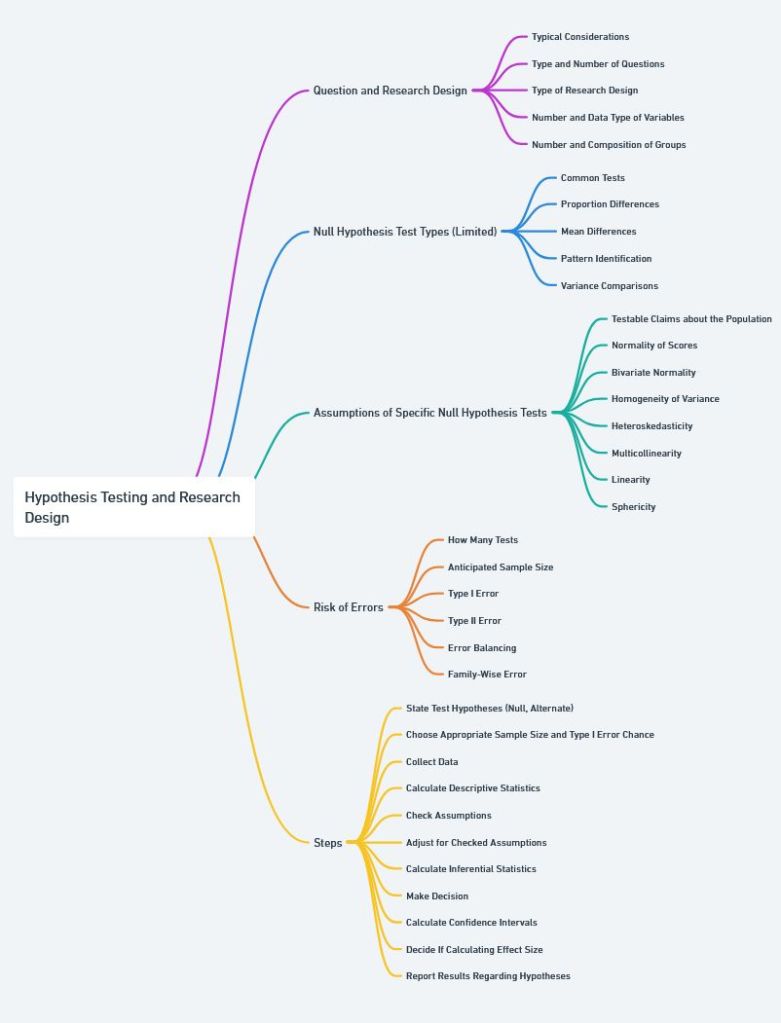
Simple Null Hypothesis Significance Testing (NHST) Mindmap

Created using Whimsical

Learning or remembering every step and requirement of the Null Hypothesis Significance Testing (NHST) framework is difficult. There are many complex concepts and choices that need to be learned and understood in order to make accurate decisions.

The NHST framework is intended to set up a logical, consistent, and accurate set of steps that help determine whether data taken from a sample supports the idea that a) there is no effect in the population, or b) the sample data is inconsistent enough compared to a null effect that it may indicate the presence of an effect in the population (Pernet, 2015).

Remember: If we are using formulas on data, it is to figure out if there is some sort of effect. The specific formulas depend on what question you are asking.

Maybe that question is about a difference in pain reduction between two groups that have been given different migraine treatments.

Maybe that question is about a difference between the proportion of product produced and the proportion of product purchased in order to determine if production lines need to be adjusted.

It is important to remember is that that randomly collected groups of people can have characteristics and scores which are very different from a simple population average. This makes the use of very small groups or sample sizes (n<30) unreliable, since the one extreme score when there are a total of 5 scores may severely sway summary statistics.

Balancing this consideration with the type of research design we are using helps ensure that our test results are as accurate and reliable as possible, and allows us to imagine what kinds of errors we might make. We can use that imagination (and some calculus from the math department) to decide on specific error probabilities based on the research design, question(s), and sample size(s) we are using.

Each type of test that uses the NHST framework was developed to help answer a specific type of question using a specific type of data.

For instance, if a researcher studying Reaction Time (in second) had an experiment where one group of 50 people received 0mg of caffeine, and another independent group of people received 500mg of caffeine, they might want to determine whether there was or was not an impact of caffeine on Reaction Time. The Student’s T-test for Two Independent Samples helps answer this question, but a component of this test requires that any treatment affecting the scores only change the mean, not the variability.

This type of requirement is integrated into the NHST framework as an Assumption, which must be confirmed before continuing with a chosen inferential statistic. Data that does not conform to assumptions may be evidence that there is a different type of effect than the test can accurately work with, so we must be able to validate our data to ensure accurate conclusions.

2024-10-15